Process Decides Performance: The Membrane and 316L Stainless Steel Behind Our Ultrafiltration Systems
We spin the membrane and weld the housing ourselves. Those two parts decide whether the system still holds its flow a few years down the road.
Membrane, housing and finished unit are all made in our own workshop. The membrane runs imported raw material through our own spinning process, so flux and service life stay more consistent. The housing is welded 316L stainless steel, with no threaded joints to work loose under repeated pressure and the loaded sections reinforced. Years in, it resists corrosion and pressure better than a plain shell and keeps its finish. The housing is not a consumable: what you replace on schedule is the element, not the shell.
Most product pages talk about filtration accuracy and stop there, but accuracy is only the starting point. Whether a system still works at close to full flow two or three years later comes down to two things: how the membrane is made and how the housing is built.
This page covers both, and how they work together to slow flux decline and keep output stable over years of service.
1. The Membrane: Two Materials, Two Jobs
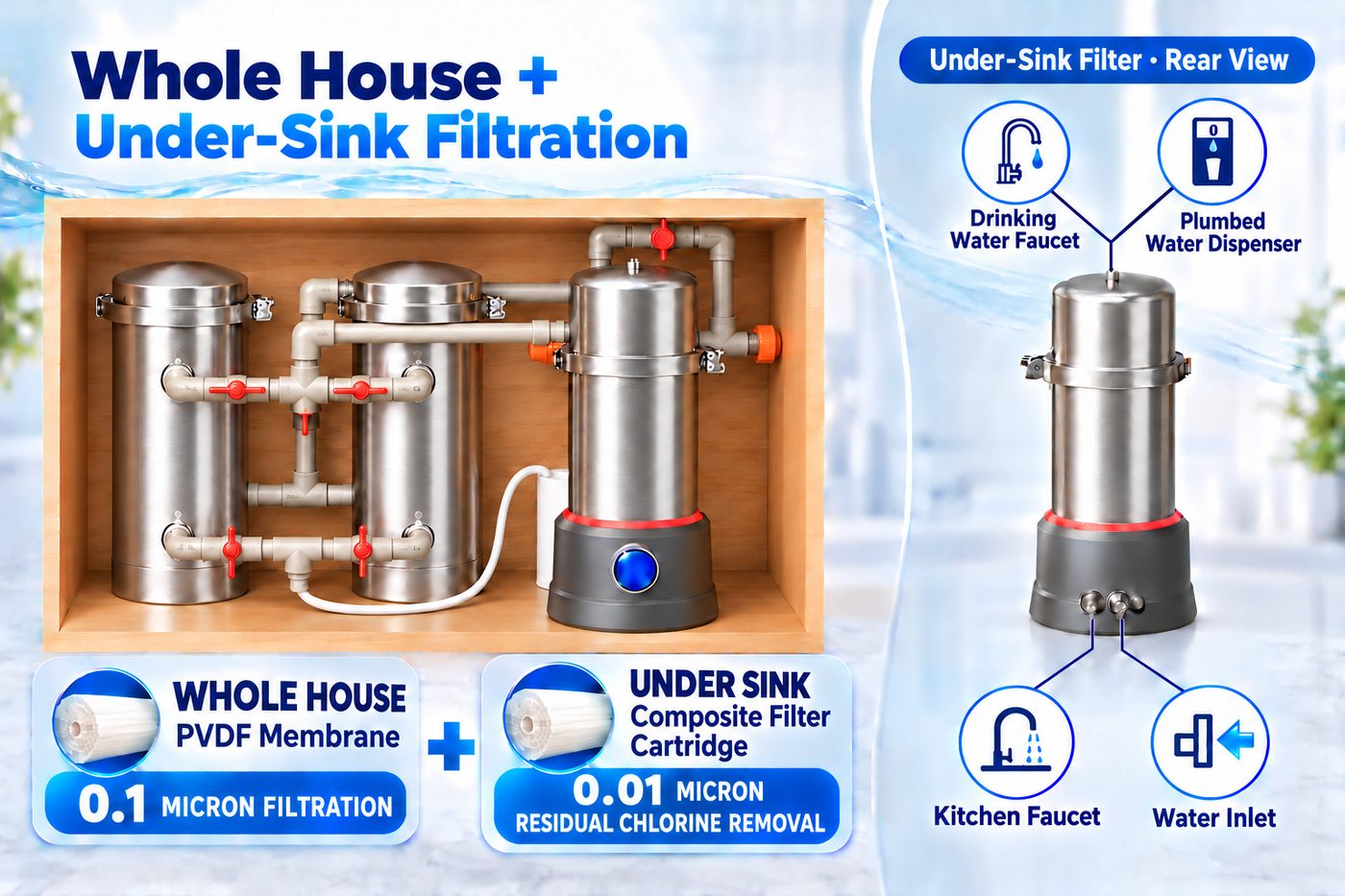
Our product line uses two different ultrafiltration membranes, because point-of-entry and point-of-use filtration face completely different problems.
| Specification | PVC hollow-fiber membrane | PVDF reinforced (braided) membrane |
|---|---|---|
| Used in | Under-sink water filter | Whole-house pre-filter |
| Pore size | 0.01 µm | 0.1 µm |
| Flow direction | Inside → out (internal pressure) | Outside → in (external pressure) |
| Primary job | Final polishing, chlorine removal, drinking water | Bulk removal of sand, rust, suspended solids and cysts |
| Cleaning | Self-flushing via the kitchen-use outlet | Manual surface cleaning + backwash |
The PVC membrane has a nominal pore size of 0.01 µm. In real production the pores are not perfectly uniform, and a very small number fall outside that value, roughly between 0.01 and 0.05 µm. The same applies to our PVDF membrane: its nominal pore size is 0.1 µm, and a very small number of pores fall between 0.1 and 1 µm.
1.1 PVC hollow-fiber membrane (0.01 µm nominal)
This is the heart of our under-sink water filter. Water is fed into the fiber lumen and pushed outward through the micropores in the fiber wall; the filtered water is collected on the outside.
It is this internal-pressure design that makes the dual-outlet flushing function possible. Open the drinking-water tap and you get mineral-style drinking water; open the kitchen-use tap and, while water flows normally, the impurities filtered out inside the fiber lumen are washed away. (See the under-sink water filter page.)
This membrane also goes through polymer modification: functional groups are built into the membrane material itself, so the membrane takes part in chlorine reduction rather than leaving it all to the activated carbon fiber ahead of it. That is why our purifier can run at high flow and still deal with residual chlorine effectively.
1.2 PVDF reinforced membrane (0.1 µm nominal)
This membrane is used in the whole-house pre-filter. It is cast onto a braided support, which is why a single fiber is very hard to pull apart.
That strength, however, is not the point. The braid is a commodity component, and tensile strength is much the same from one supplier to another. What actually determines quality is the separation layer bonded onto the surface of that support — the layer where filtration happens. (For how it is cleaned, see the whole-house pre-filter page.)
Water is pushed from outside to inside, so particles are rejected on the fiber surface. Clean the fibers on a regular basis and fouling is dealt with, filtration capacity is restored, and the element keeps working for years.
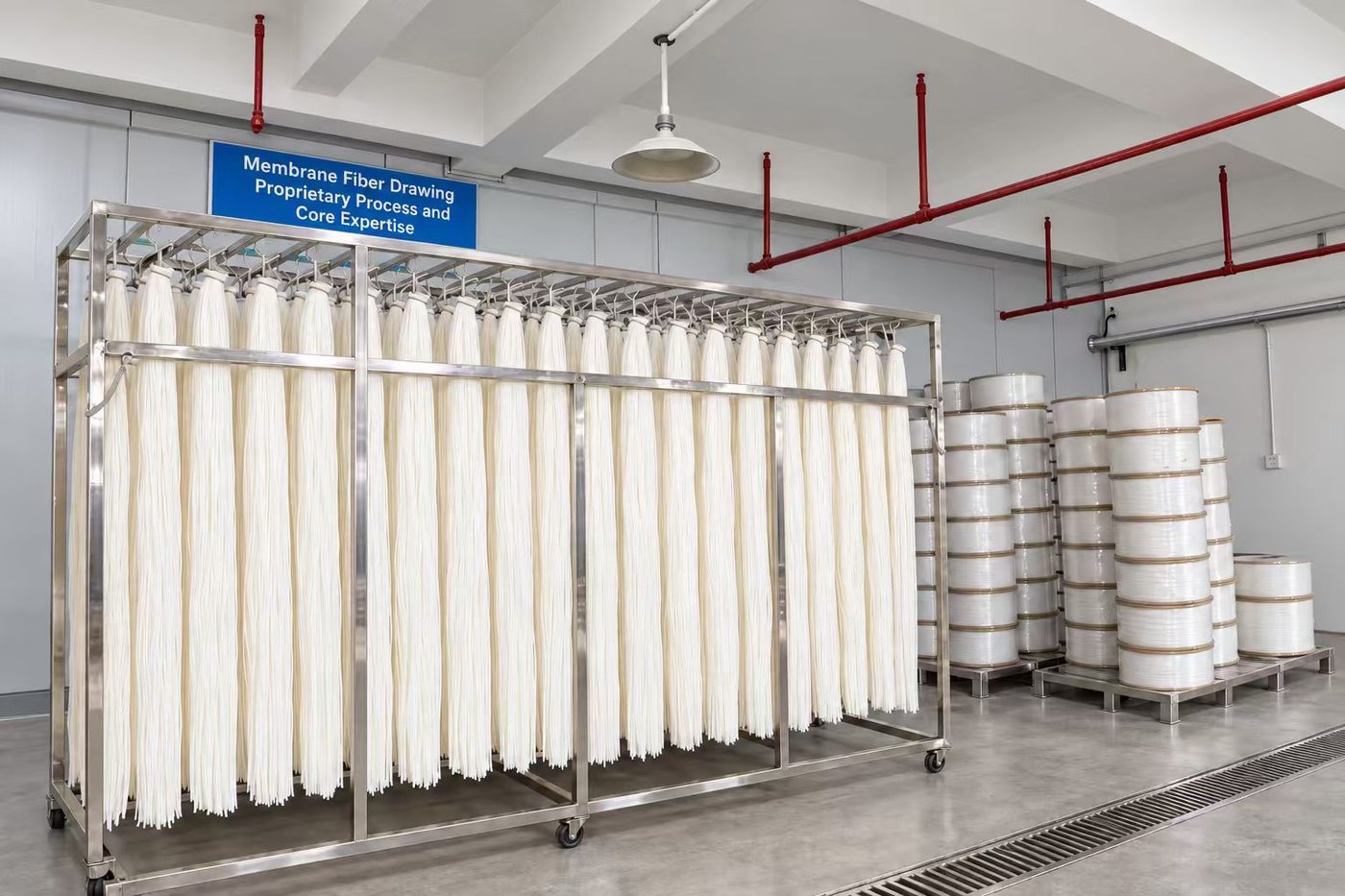
1.3 Spinning and potting
Three process details that never appear on a spec sheet, but decide consistency:
- Single-hole spinnerets. A multi-hole spinneret runs faster, but fibers from different hole positions cool at different rates, so the structure and pore distribution of the bundle vary. We use single-hole spinnerets with controlled spinning parameters, so the micropores are dense and uniform from one fiber to the next.
- Two-stage A/B adhesive potting. The fiber bundle is sealed with a secondary helical mixing, constant-temperature curing process. Potting integrity matters more than it sounds — a weak potting joint is a leak waiting to happen.
- Clean finishing. Finished membranes are first soaked in purified water, then disinfected and rinsed with an alcohol solution, so the membrane carries no chemical odor and needs no extra chemical post-treatment.
2. The Housing: 316L Stainless Steel, Welded, and Thick Enough
A membrane is only as durable as the housing that contains it. Our housings are welded 316L stainless steel, with wall thickness held above the minimum for the rated pressure cycle.
| Specification | What we use | Why it matters |
|---|---|---|
| Material | Standard 316L stainless steel | Better resistance to chloride pitting than 304 over long service; how much it matters depends on your water |
| Construction | Welded body | No threaded joints to loosen under repeated pressure cycling |
| Wall thickness | Above the minimum required for the rated pressure cycle | Housing pressure limits and pressure-cycle test results are available on request |
| Surface | Polished inner and outer, then ultrasonically cleaned | Removes oil and debris from areas no one can inspect after installation |
The result: a housing that stands up to chlorinated water, takes repeated pressure cycling, and is designed to outlast the membrane element inside it.
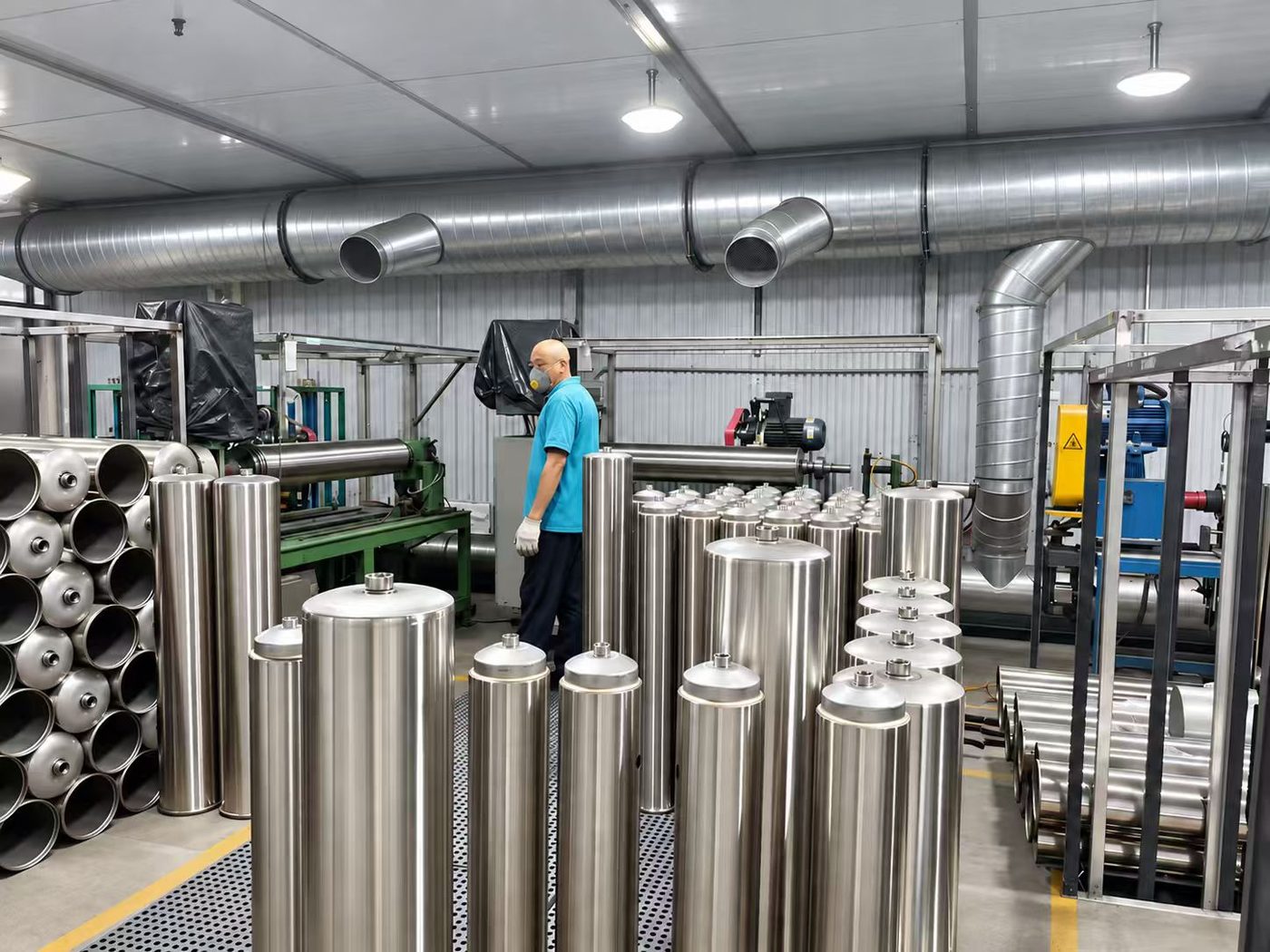
The practical meaning is simple — the housing is not a consumable. You replace the filter element on schedule; you do not replace the housing.
3. Why These Processes Raise Flux and Slow Decline
Membrane flux is the filtrate flow per unit of membrane area. Decline is how fast that flow drops as the membrane fouls and performance falls off. Both are shaped by how the membrane is made — and also by feed-water quality, operating conditions and cleaning.
Three things in the process above work directly on these two problems:
1. Uniform pore distribution → higher starting flux.
When pore size is consistent across the whole membrane surface, the entire area takes part in filtration and flux is higher. When pores are uneven, the number of effective pores varies across the membrane, and flux is lower.
2. A smooth surface and regular pore geometry → slower fouling.
The smoother the membrane surface, the fewer places contaminants have to grip; a regular pore structure means fouling accumulates evenly instead of concentrating at a few weak spots. Fouling is what causes flux decline — slow the fouling and you slow the decline.
3. A washable design → flux recovery.
This is the one that matters most in real use. A fouled membrane that can be washed can have much of its flow restored, and how much comes back depends on what fouled it and how it is cleaned; a fouled membrane that cannot be washed is simply spent. What we see in testing: manual surface scrubbing takes off the material sitting on the membrane surface fairly easily, but particles lodged in the pores resist it; backwashing drives those out of the pores and does more to restore flux.
4. Four Questions Worth Asking Before You Compare Prices
Two systems can publish the same filtration accuracy and still behave completely differently two or three years later. The difference is usually in the parts you cannot see:
- Is the pore structure uniform, or did a fast multi-hole spinneret trade consistency for output and cost?
- Is the potting done once, or twice?
- Was the housing wall thickness engineered, or is it just enough to pass a test?
- After cleaning, how much flux does the membrane recover — or does washing it make no difference?
These are the questions worth asking before you compare price. They are also the ones we are glad to answer directly.
5. FAQs
Is the nominal 0.01 µm pore size an absolute rejection rating?
No. A nominal pore size is a nominal value, not an absolute rejection rating — the pores across a membrane surface can never be perfectly uniform, and a small share will always be somewhat larger (the deviation range is given in section 1). What a membrane actually removes also depends on membrane integrity, feed-water quality and operating conditions. A single pore-size figure is not enough to judge the whole picture.
How is a 316L housing different from an ordinary stainless housing?
316L contains molybdenum, which gives it better resistance to chloride pitting than 304. For a part that stays in water for its whole service life, that is a real advantage. How much it matters still depends on your water and operating conditions.
Where is this manufactured?
In our own factory, including membrane spinning, housing fabrication and final assembly.
Can you provide test reports and certifications?
Yes — available on request.
Notes on ratings
All performance figures quoted across this site — including flow rate and total purified water volume — are based on compliant municipal tap water at normal household pressure. Real-world results depend on source water: turbidity, iron and manganese content, and contaminant load all affect service life and flow. Where your source water differs significantly, we will advise on expected performance and maintenance frequency individually.
Related: Donghe Gao home page · PVC under-sink water filter