Whole House Sediment Pre-Filter — 0.1 µm PVDF Ultrafiltration
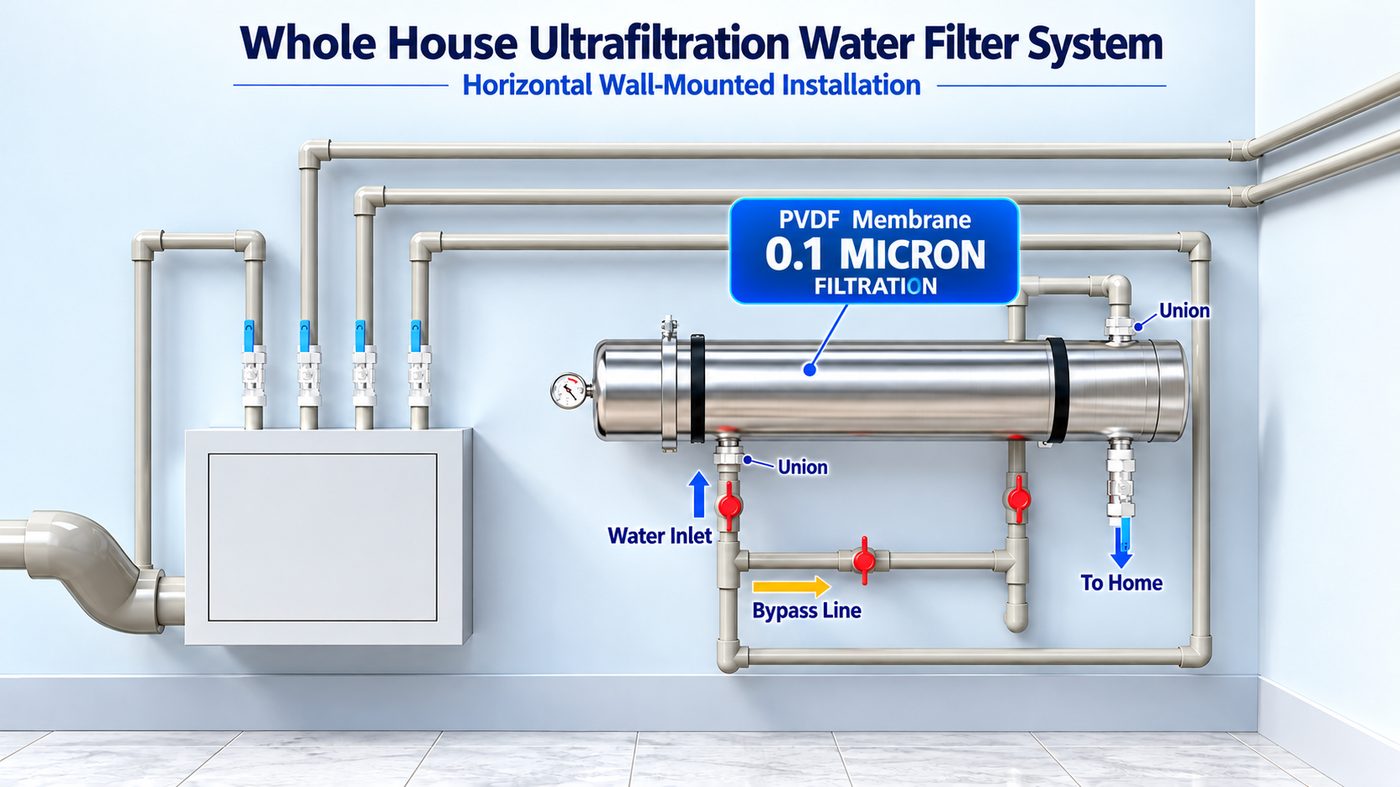
0.1 µm filtration at the point of entry. Rust, sediment, larger particles and turbidity are stopped before the water gets into the house, so muddy water runs clear. And the element is cleaned, not thrown away.
It sits where the water enters the building. A 0.1 µm braided PVDF membrane keeps out the rust, sediment, suspended solids and turbidity carried in by wells, surface water and older mains. The muddy water that shows up after heavy rain is where it earns its keep. Once the element loads up, hand cleaning plus a backwash with filtered water brings most of the flow back. A periodic clean is all it needs, and one element outlasts a stack of cartridges.
At a glance
| Specification | Detail |
|---|---|
| Nominal pore size | 0.1 µm (PVDF reinforced ultrafiltration membrane) |
| Membrane type | Braided reinforced PVDF hollow fiber |
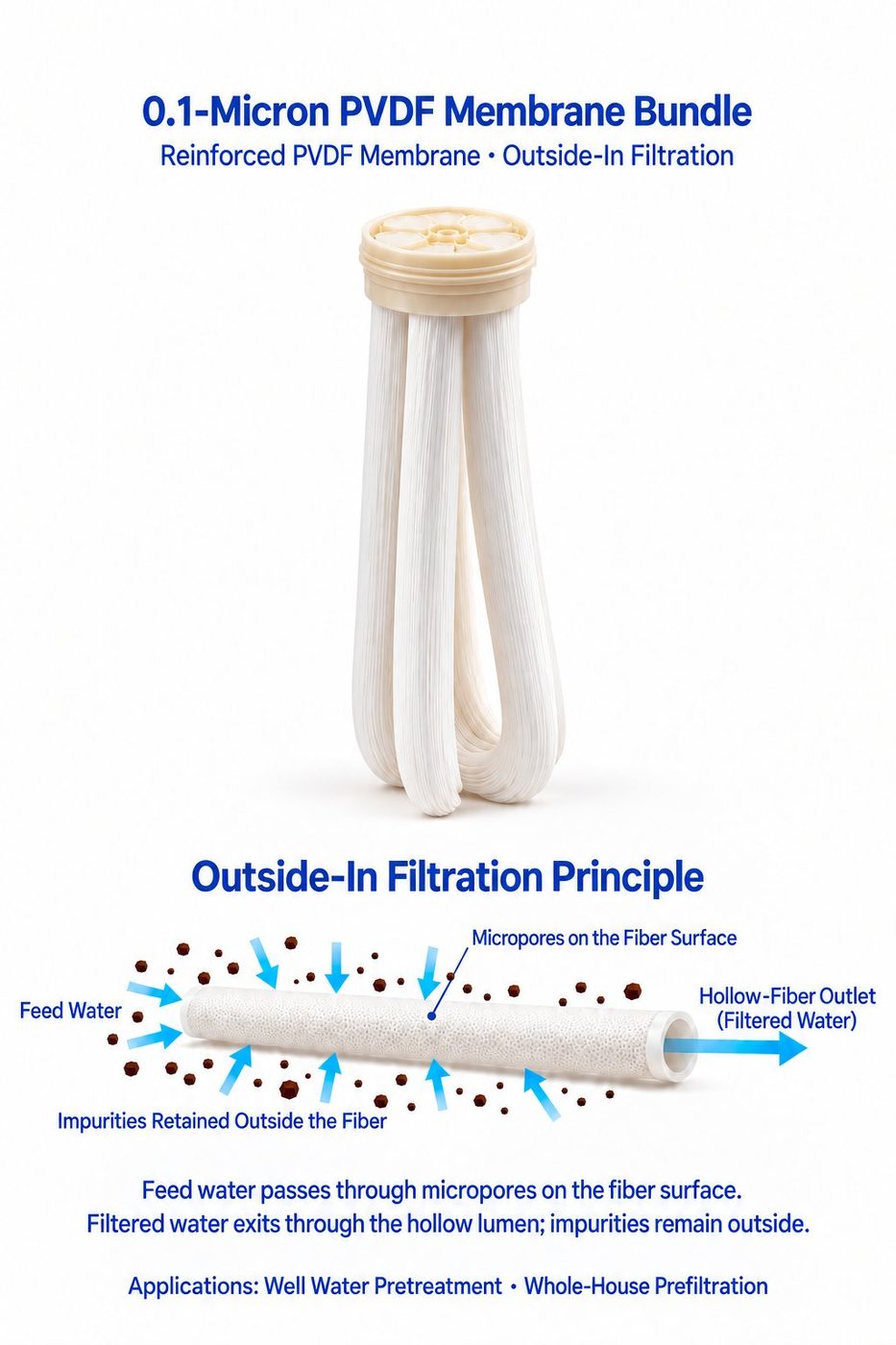
| Flow direction | Outside → in (external pressure) |
| Removes | Sand, rust, suspended solids, cysts and helminth eggs, colloids, some bacteria, turbidity |
| Cleaning | Manual surface cleaning + backwash with filtered water. Cleanable and reusable |
| Warranty | 10 years on the stainless housing; 3 years on cartridges |
| Suitable for | High-turbidity water after heavy rain, well water, river and stream water, municipal tap water — configuration depends on feed-water quality |
| Position | Point of entry (POE) — installed where the water enters the building |
| Not intended for | Removing dissolved contaminants — hardness minerals, metals, nitrates or salts; it does not soften water, and it is not intended for virus removal |
Note: a very small number of pores fall outside the nominal value, in the range of 0.1–1 µm; a nominal pore size is a nominal value, not an absolute rejection rating.
1. What a pre-filter is actually for
A whole-house pre-filter does one job: catch coarse particulate contamination before it reaches everything downstream.
That means:
- Cleaner water at every tap, not just the kitchen;
- Less sediment settling in tanks, water heaters and pipes;
- Less particulate loading on the under-sink water filter, the washing machine, the water heater and other downstream equipment.
It is the first line, not the last. For drinking water you normally still want an under-sink water filter.
2. External pressure: why this membrane can be cleaned
This is the one thing about this unit that is worth understanding properly.
The PVDF membrane works on external pressure: water is pushed from outside the fiber to the inside, and filtered water leaves through the fiber lumen.
That means contaminants are rejected and held on the outer surface and at the pore mouths.
How cleaning works
| Step | Action | What it removes |
|---|---|---|
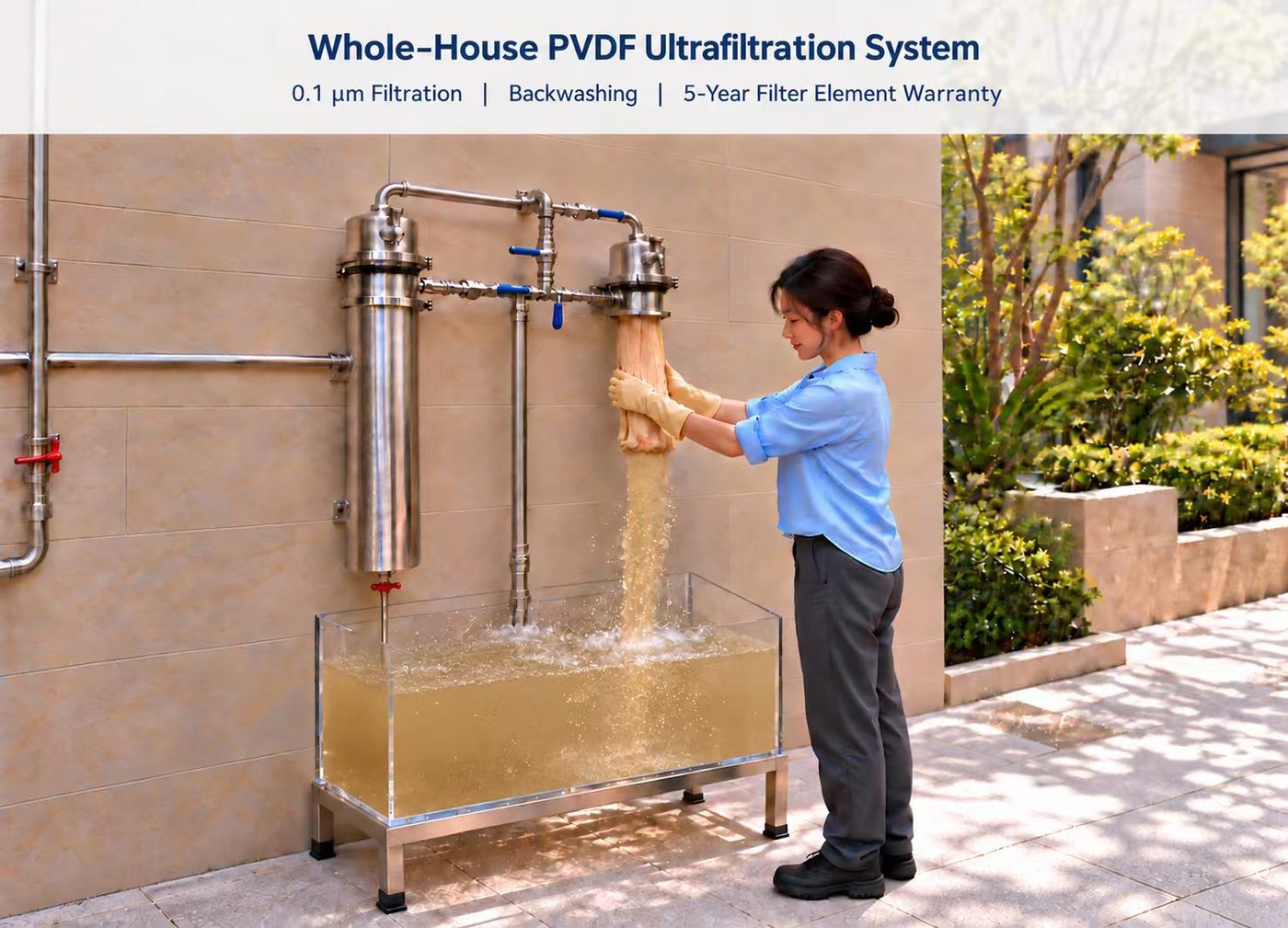
| Manual surface cleaning | Release the stainless steel clamp, take the housing off and expose the element, then work the outer surface by hand | The cake layer built up on the membrane surface |
| Hand cleaning + backwash | Open the backwash valve at the same time and drive filtered water from inside the fiber outward through the pores, while working the surface by hand | Particles lodged in the pore channels, plus debris on the membrane surface |
The two steps do different jobs. Wiping the surface cannot clear what is lodged in the pores, so a simple rinse never fully restores flow. Driving filtered water back through the pores while cleaning by hand is what recovers membrane flux.
Why this matters more than the accuracy number
In high-turbidity water — a well after rain, or a stream in the rainy season — the problem is not that the membrane cannot filter, it is how fast it blocks.
A filter that has to be replaced once it blocks is a recurring expense. One that can be washed back to usable flow costs less.
3. Where it is used
| Source | Typical problem | How the pre-filter helps |
|---|---|---|
| Well water | Sand, silt, iron rust, seasonal turbidity | Removes visible particulate; cleanable after heavy use |
| High-turbidity water after heavy rain | Very high turbidity | Handles the load, then is washed back rather than replaced |
| River / stream water | Suspended solids, cysts, sediment | Continuous coarse filtration at point of entry |
| Municipal tap water | Pipeline rust and sediment from older mains | Holds rust and sediment back before the water enters the building |
For municipal supply, the benefit is mainly protective — keeping rust and sediment out of your plumbing and appliances. For well, stream and surface water it is a sediment and turbidity barrier; whether it suits your water, and in what configuration, depends on the water quality and on the system design downstream.
4. Braided reinforcement — what it means and what it does not
The membrane is cast onto a braided support, which is why a single fiber is very hard to break by hand.
Let us be plain about this: it is not a differentiating selling point. The braid is a commodity component, and tensile strength is much the same from one supplier to another. Pulling on a fiber is not a test of filtration performance.
What actually determines quality is the separation layer bonded onto that support — the layer that contains the pores. Its thickness, uniformity and material quality decide service life and flux stability, and none of that can be seen by pulling on a fiber. How that layer is made is described on our how the membrane is made page.
5. Why ultrafiltration here, and not a PP sediment cartridge
| Item | PP sediment cartridge (e.g. big blue / large housing) | This 0.1 µm PVDF pre-filter |
|---|---|---|
| Nominal pore size | Typically 1–5 µm | 0.1 µm |
| Removes | Larger sand and rust particles | Fine silt, colloids, cysts and helminth eggs, some bacteria |
| When it blocks | Must be replaced | Can be cleaned by hand and backwashed |
| Behavior in muddy water | Blocks rapidly, then nothing gets through | Blocks, then is cleaned and returned to service |
| Long-term cost | Recurring cartridge purchases | One unit, cleaned periodically |
A PP cartridge is cheap to buy. In muddy water it is expensive to own — you keep paying for the same filtration. An ultrafiltration pre-filter costs more up front; how often it needs cleaning, and how long the element lasts before replacement, depend on your source water.
6. Pairing with an under-sink water filter
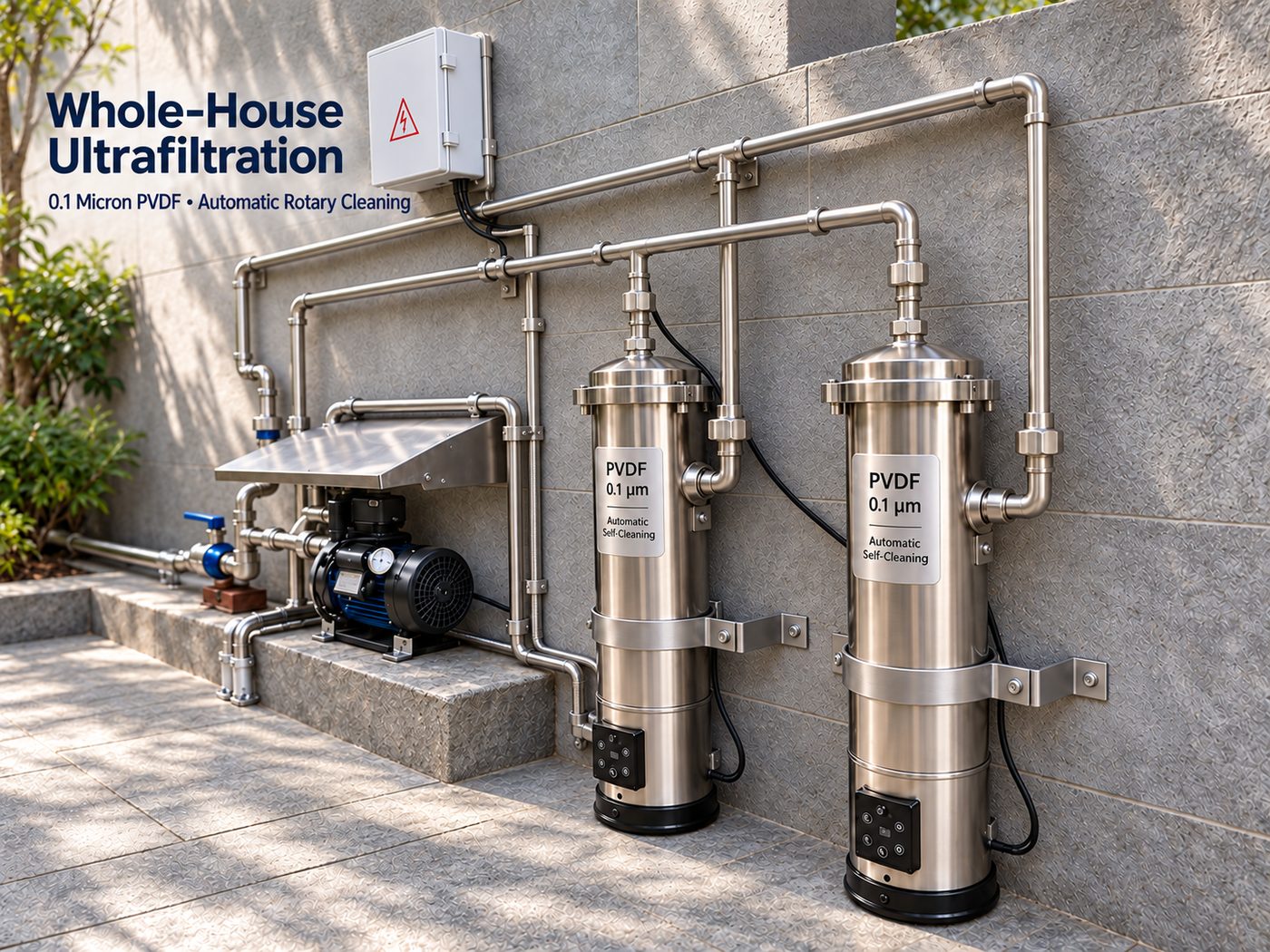
The two are designed to work as a sequence:
- Pre-filter (point of entry, 0.1 µm) — removes sand, rust, silt and turbidity, protecting the whole building and everything in it.
- Under-sink water filter (point of use, 0.01 µm) — final polishing and chlorine removal, to drinking-water quality.
Without the pre-filter, the under-sink unit has to carry all the coarse contamination itself, and its cartridge exhausts much faster. This pre-filter is what keeps the downstream unit economical. The under-sink water filter has its own page.
7. FAQs
How often does it need cleaning?
It depends on your source water. Municipal supply in good condition may need attention only occasionally; a well after heavy rain may need it far sooner. If you notice the flow dropping, that is the signal — clean the element.
Is cleaning difficult?
Not difficult. Release the stainless steel clamp, take the housing off, and the element is in front of you. Open the backwash valve and clean the element by hand while backwashing; that recovers membrane flux better.
Can it be used on its own for drinking water?
It is designed as a pre-filter. If you do drink its output, boil it first — boiling addresses microbes, not dissolved chemicals — and suitability still depends on your water.
What does the warranty cover?
It differs between models.
My water comes out yellow or rust-colored. Can this handle it?
It depends on where the yellow comes from. Appearance is only a clue, not a test: it cannot tell you whether the water is safe or exactly what is in it. One simple observation still helps narrow it down: draw a glass of water and look at the color right as it comes out.
• If it comes out brown right away and you can see sediment in it, that is particulate — rust, silt and sand. It is exactly what this pre-filter is meant to catch: it holds it back, you wash it off, and you carry on.
• If it comes out clear and turns yellow only after standing in the glass, that is dissolved iron (ferrous iron oxidizing on contact with air). Particle filtration does nothing for it, and you need dedicated iron-removal equipment downstream.
The water looks white and milky — is that a water quality problem?
Usually not. In well water, or in systems with a pressure tank, water dissolves air under pressure; when it leaves the tap and the pressure drops, that air comes out as a mass of tiny bubbles and the water looks white and cloudy. The test is simple: fill a glass and leave it a few minutes — if it clears by itself, it was bubbles and has nothing to do with water quality. If it is still cloudy after standing, or you can see fine suspended matter, then it is real turbidity, and that is what this pre-filter is there to handle.
My well water contains iron. Is this unit enough?
First work out which form of iron you have. Particulate rust and iron-bearing sediment it can hold back; iron dissolved in the water it cannot, and that needs dedicated iron removal downstream. Wells have another quirk: iron in the water feeds iron bacteria, which over time form a reddish-brown slimy film on pipes and filter surfaces and clog the membrane pores — which is why well-water users have to clean more often than people on municipal supply. There is only one precondition for using well water: the source itself is safe, and that part is yours to confirm.
Can it remove dissolved iron or reduce water hardness?
No. It holds back particles — silt, rust, suspended solids. Iron dissolved in the water, and the calcium and magnesium that determine hardness, are outside what it handles. This filter keeps coarse particles out of the house; it is not a softener and does not remove salts. Dissolved contaminants have to be dealt with by equipment downstream.
Notes on ratings
Performance depends on source water. Turbidity, iron and manganese content, and contaminant load all affect both flow rate and cleaning frequency. Tell us what you know about your source water and we will give you an expected maintenance interval for your situation.
Related: Donghe Gao home page · how our ultrafiltration membranes are made