Under-Sink Water Filter — 0.01 µm PVC Ultrafiltration
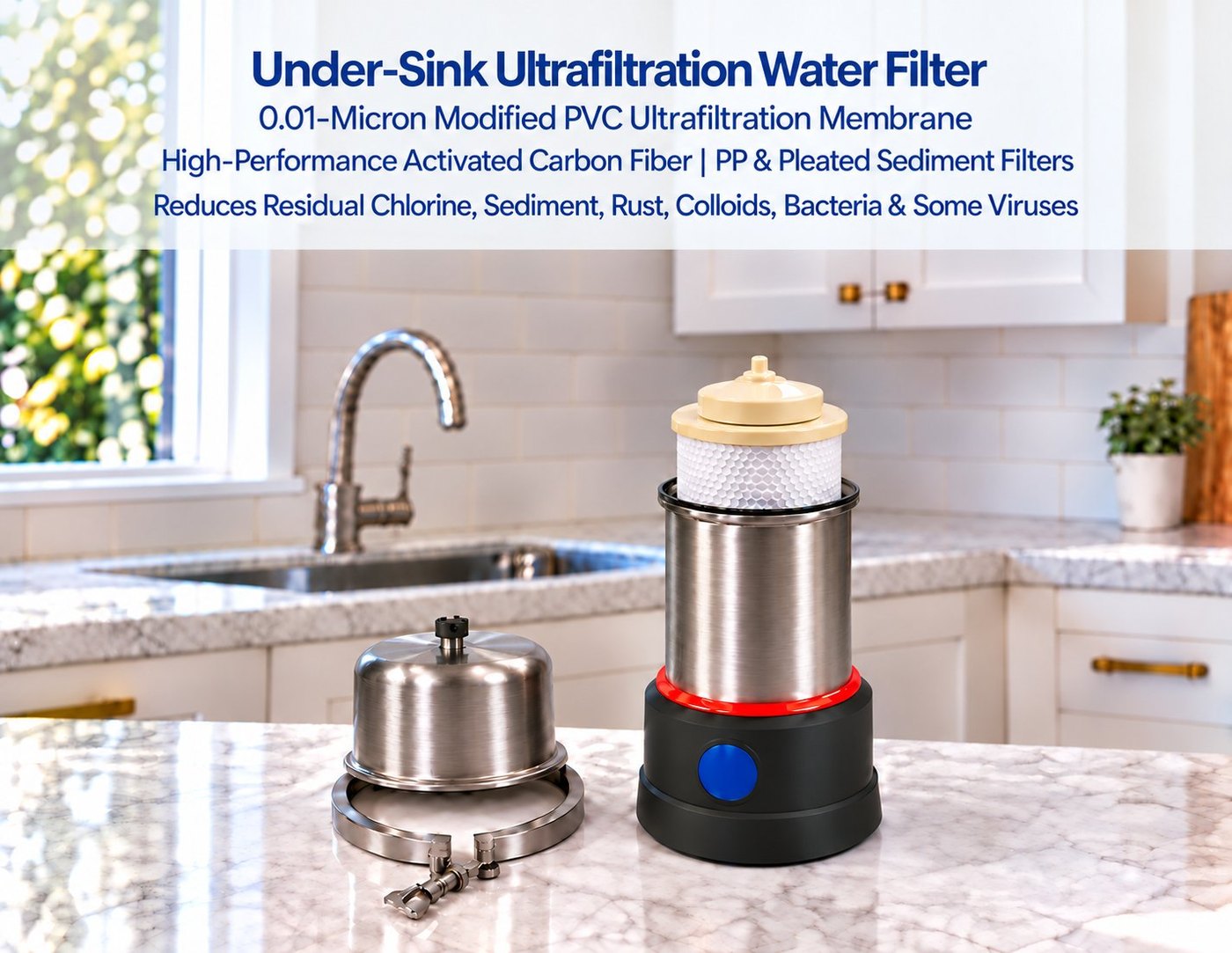
0.01 µm physical filtration in a four-stage cartridge. Bacteria, colloids and some viruses are held back by the membrane; residual chlorine is handled separately, by adsorption on the activated carbon fiber and by reduction at the membrane’s functional groups. Calcium and magnesium stay in the water. 100 m³ of rated capacity at 8–10 L/min, so the kitchen tap keeps its pace.
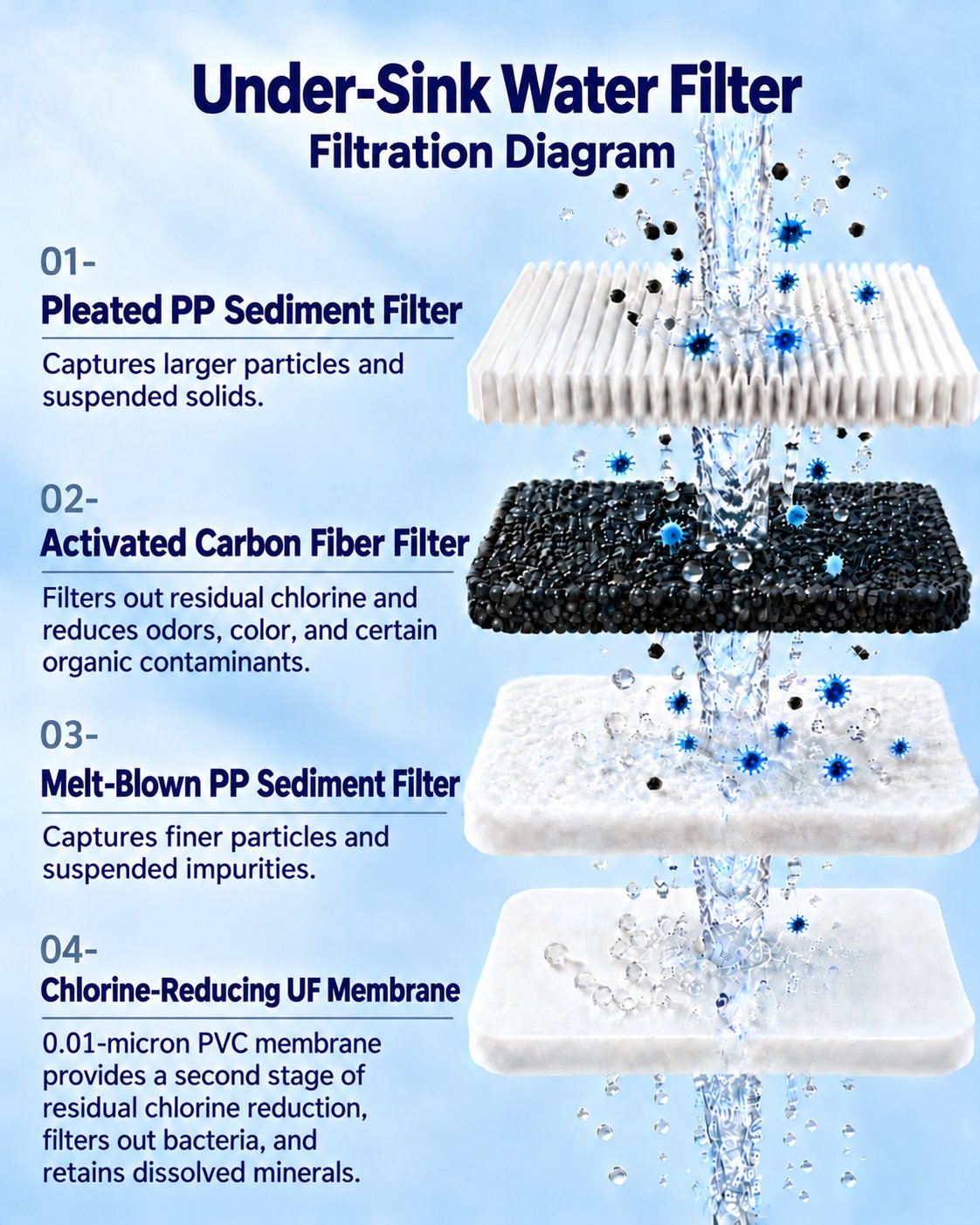
Four stages, one job each. Pleated PP catches the larger particles. Activated carbon fiber takes out residual chlorine and sharpens the taste. Melt-blown polypropylene polishes the finer particles and protects the membrane behind it. The last stage is a 0.01 µm modified PVC ultrafiltration membrane, the final barrier for bacteria, colloids and some viruses; its functional groups also reduce the remaining chlorine to chloride, which is why chlorine is handled twice. Rated for 100 m³ (100,000 L) of purified water, at 8–10 L/min on compliant municipal tap water at normal household pressure.
At a glance
| Specification | Detail |
|---|---|
| Nominal pore size | 0.01 µm (PVC hollow-fiber ultrafiltration membrane) |
| Filter configuration | 4-stage composite: pleated PP · activated carbon fiber · melt-blown polypropylene · PVC ultrafiltration membrane |
| Flow rate | 8–10 L/min (2.1–2.6 US gpm) on compliant municipal tap water at normal household pressure |
| Total purified water volume | 100 m³ (100,000 L / approx. 26,417 US gal), based on compliant municipal tap water at normal household pressure |
| Removes | Sediment, rust, suspended solids, bacteria, colloids, some viruses, residual chlorine |
| Retains | Calcium, magnesium and other naturally occurring minerals |
| Waste water | No reverse osmosis concentrate stream. Filtration itself does not require electricity |
| Plumbing connections | Three — one feed inlet plus two taps, both standard: a drinking-water tap and a kitchen-use tap. Opening the kitchen-use tap flushes the membrane lumen |
| Suitable for | Compliant municipal tap water; well water confirmed safe through testing or treatment. Drinking, cooking, washing produce |
Note: a very small number of pores fall outside the nominal value, in the range of 0.01–0.05 µm; a nominal pore size is a nominal value, not an absolute rejection rating.
1. What it removes, and what it keeps
This is an ultrafiltration water filter, so it works by physical separation — it does not strip everything out of the water at once.
Removed:
- Suspended solids, sediment and rust particles
- Bacteria and colloids
- Some viruses
- Residual chlorine (handled twice — see below)
Retained:
- Calcium, magnesium and other dissolved minerals
That distinction is the key. If your water source is already safe, the goal is to remove what the pipework brought in — not to remove what the water naturally contains.
2. Four stages, each doing one specific job
| Stage | Media | Job |
|---|---|---|
| 1 | Pleated PP | High-capacity capture of larger particles |
| 2 | Activated carbon fiber | Removes residual chlorine and improves taste |
| 3 | Melt-blown polypropylene | Polishing capture of finer particles, protects the membrane |
| 4 | PVC ultrafiltration membrane (0.01 µm) | Final barrier: bacteria, colloids, some viruses — plus secondary chlorine removal |
Why the fourth stage is different
Most purifiers rely on a carbon block alone to deal with chlorine. That creates a trade-off: the faster the water moves, the shorter its contact time with the carbon, and the less chlorine is removed — so the flow has to be throttled back, which makes the unit unpleasant to use.
Our under-sink water filter is built to keep the flow high:
- A larger activated carbon fiber layer than is common in this class, so residual chlorine is dealt with quickly even at high flow;
- A modified chlorine-reducing membrane as the fourth stage — the membrane material itself carries functional groups that react with residual chlorine and remove it.
The result is a system that does not have to slow the water down in order to filter it. That is where the 8–10 L/min rating comes from, on compliant municipal tap water at normal household pressure. To see how this membrane is spun and potted, see how the membrane is made.
3. Two outlets — and one of them cleans the filter
This purifier connects to two outlets at the tap:
- Drinking-water outlet — filtered water for drinking, cooking and making beverages.
- Kitchen-use outlet — higher-volume water for washing vegetables, rice and dishes, and general kitchen use.
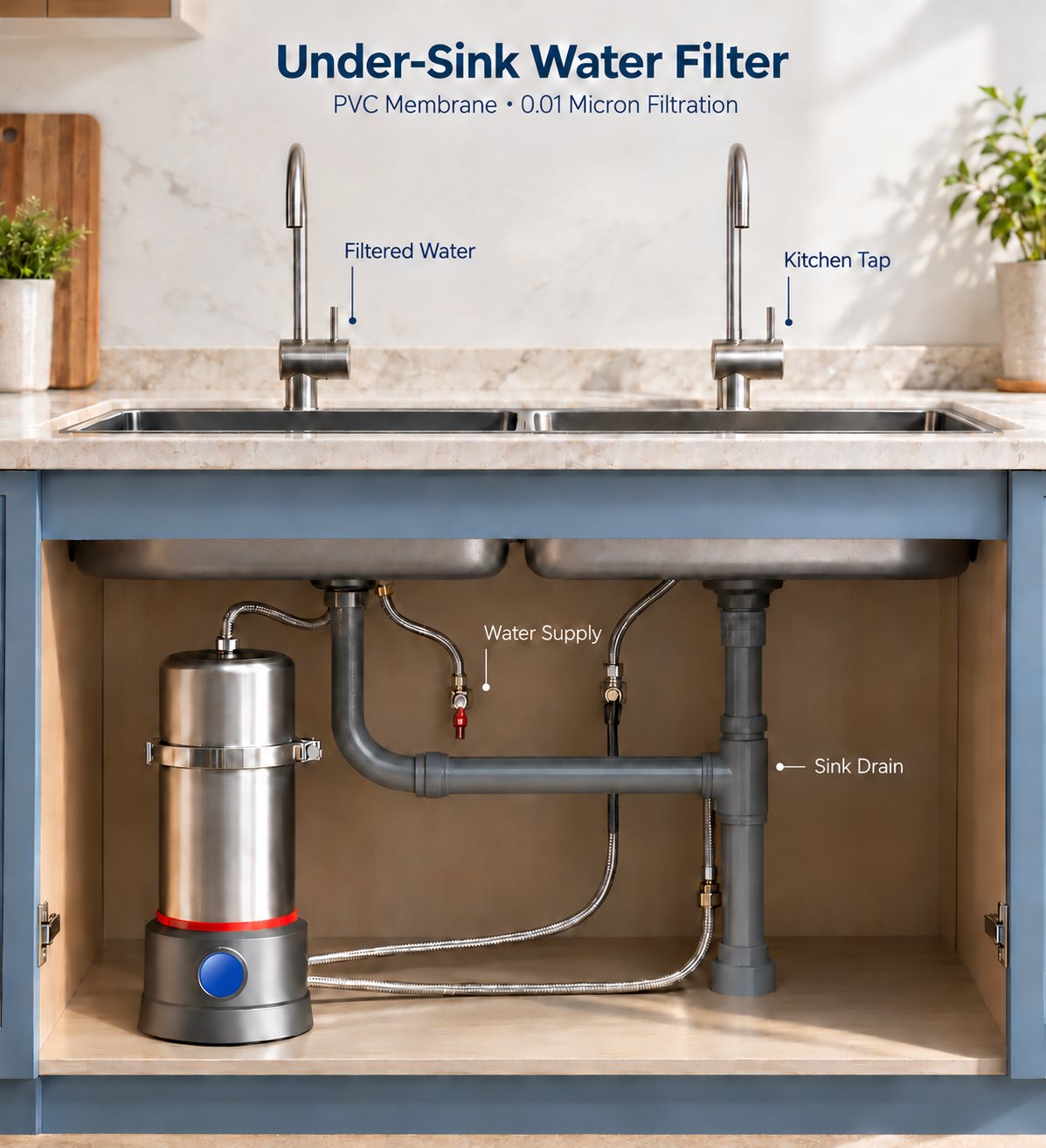
Here is the part worth knowing: when you open the kitchen-use outlet, you are also flushing the cartridge.
The internal-pressure design
The PVC membrane works on internal pressure: water is fed into the inside of each hollow fiber and pushed outward through the pores in the fiber wall, and the filtered water collects on the outside.
Because contaminants accumulate on the inner surface — the side the feed water touches first — running a high-volume flow through the inside of the fibers carries that accumulation away and out of the cartridge.
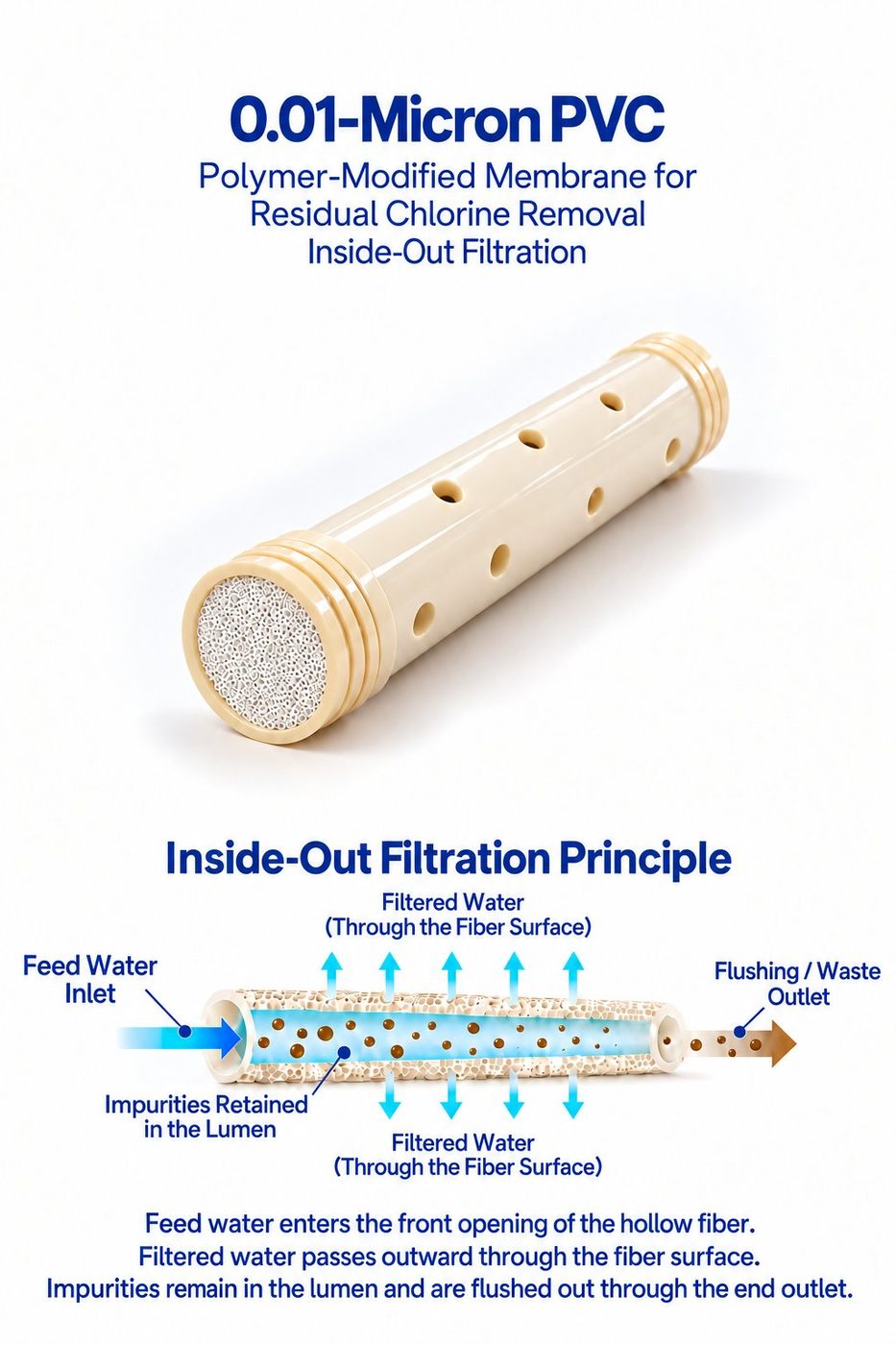
So washing vegetables or rice keeps the cartridge flushed. There is no separate routine to keep and nothing to take apart just to flush it. It is not the whole of maintenance, though: the cartridge is a consumable, and it still has to be replaced when it reaches its rated volume or your water conditions call for it. That flushing comes from the internal-pressure design, a structural feature rather than an added function.
4. Flow rate: what 8–10 L/min means
| System | Calculated membrane production rate | Time to fill a 125 mL glass |
|---|---|---|
| Reverse osmosis — 400 GPD | ~1.05 L/min (0.28 US gpm) | ~7.1 s |
| Reverse osmosis — 800 GPD | ~2.10 L/min (0.56 US gpm) | ~3.6 s |
| Reverse osmosis — 1200 GPD | ~3.16 L/min (0.83 US gpm) | ~2.4 s |
| This under-sink water filter | 8–10 L/min (2.1–2.6 US gpm) | ~0.9 s |
Conversion basis: 1 GPD (US gallon per day) = 3.785 L/day; the glass is taken as 125 mL. GPD is the membrane’s production capacity over 24 hours — it is not the same as the instantaneous flow at the tap of a reverse osmosis system with a storage tank.
A reverse osmosis system has to push water through a 0.0001 µm membrane under pressure, so its output is limited by membrane area and pump capacity. Ultrafiltration at 0.01 µm runs on household water pressure alone. RO is not slow because it is badly made — it is slow because it is asked to do a different job.
The practical difference is not just a glass of drinking water. At 8–10 L/min, the same tap can fill a pot for soup, wash a bowl of rice or rinse a plate of fruit — jobs that are a stretch through a low-flow RO drinking tap.
5. Total purified water volume: the number that decides cost
Cartridge life is not counted in months. It is counted in liters.
| System class | Total purified water volume (typical published range) |
|---|---|
| Entry level | 4,000–6,000 L |
| Mid-range | 8,000–12,000 L |
| Many premium systems | around 50,000 L |
| This under-sink water filter | 100,000 L |
Those figures are the ranges commonly published in this category; brands do not all measure them the same way. What the comparison shows is the order of magnitude.
A unit rated at 4,000 L looks fine if you only drink from it. But a realistic family kitchen also cooks, washes rice, brews coffee and rinses produce. At 20 L a day of kitchen use, a 4,000 L unit is used up in about 200 days and a 6,000 L unit in about 300 days — and that is before any extra load from guests or seasonal use.
This filter is rated at 100,000 L — on that same daily use, sixteen to twenty-five times a 4,000–6,000 L cartridge. That is the arithmetic.
One thing worth saying plainly: 100,000 L does not mean ten years of use. The element itself ages, which is why it carries a warranty period rather than an unlimited life. Treat the figure as rated capacity under the stated feed-water conditions, not as a guarantee that nothing else will need attention.
6. Where it fits — and where it does not
Recommended for:
- Compliant municipal tap water
- Well water that is safe at the source and confirmed drinkable
- Households that want to keep the minerals in their water
- High kitchen water use (cooking, washing produce, filling pots and pans)
Not recommended for:
- Water with heavy-metal levels above limits
- Water with nitrate or nitrite above limits
- Very hard water where the main goal is scale control
In those cases the right choice is a reverse osmosis system — that is what it is designed for. If you are unsure, tell us the actual situation with your water; we will tell you plainly whether this unit suits you.
7. FAQs
Does it remove minerals?
No — that is by design. Calcium and magnesium stay in the water.
Does it remove chloramine?
Let us be upfront: chloramine reduction has not been verified for this system. Our existing reports cover free chlorine and disinfection byproducts, and chloramine is not among the tested parameters. Here is why the question comes up: the cartridge handles disinfectant residue through the same two mechanisms as free chlorine. One is a layer of activated carbon fiber that adsorbs the residue and reacts with it at the surface; the other is a polymer-modified membrane whose functional groups reduce it to chloride. In chloramine (chlorine bound to ammonia), the chlorine is in the same +1 oxidation state as free chlorine, so the same chemistry can reduce it; but the N–Cl bond is more stable than the O–Cl bond, and the reaction needs a longer contact time. If your water utility disinfects with chloramine, send us your water report and we will tell you honestly what to expect.
There is a chlorine smell in my water, like bleach. Can this remove it?
Yes. That smell comes from disinfectant residue — municipal water is widely chlorinated, so most households run into it to some degree. The cartridge handles it in two layers: an activated carbon fiber layer that both adsorbs the residue and reacts with it at the surface, plus a polymer-modified membrane that reduces the remaining chlorine to chloride. First, though, work out where the smell comes from: if what you notice is not chlorine but sulfur, mustiness or an odor picked up from the pipework, the cause is different and so is the fix — describe it to us and we will help you work out what it is.
Does it produce waste water?
There is no reverse osmosis concentrate stream to drain away. Filtration itself does not require electricity.
How is this different from an RO system?
Reverse osmosis (0.0001 µm) removes dissolved solids including minerals, drains a concentrate stream, may require electricity depending on the configuration, and runs at a much lower flow rate. This unit (0.01 µm) removes suspended particles, bacteria, colloids and residual chlorine while retaining minerals, with no RO concentrate stream and a far higher flow. Choose based on your source water, not on which number is smaller.
Do I need to clean it?
No disassembly is required for routine flushing — opening the kitchen-use outlet flushes the membrane lumen as part of normal use. The cartridge itself is replaced when it reaches its rated capacity.
Can it soften water or prevent scale?
No. This unit does not soften water and does not reduce dissolved hardness — calcium and magnesium stay in. That is the flip side of keeping the minerals, and it is also why it cannot deal with scale. If your main goal is preventing scale, look at a softening system rather than this unit.
Can it remove iron?
It depends on which iron. Rust particles in the water — the red suspended matter — are particulate and can be filtered out; iron dissolved in the water (which usually shows as yellowish water and a metallic taste) is outside what this unit handles. So establish first whether it is particulate or dissolved iron, and then decide what equipment to use.
Can it remove lead, PFAS and similar substances?
We do not make that claim. This is 0.01 µm physical filtration; it mainly deals with suspended particles, bacteria, colloids and residual chlorine. Whether substances like lead and PFAS are removed depends on the specific substance and its form, and we have not tested for them, so we do not publish removal rates. If your water has this kind of problem, send us what you know about it and we will tell you how to deal with it in your situation.
Notes on ratings
Flow rate (8–10 L/min) and total purified water volume (100,000 L) are based on compliant municipal tap water at normal household pressure. Actual performance varies with feed-water quality — turbidity, iron and manganese content, and overall contaminant load all affect both flow and service life. Tell us what you know about your source water and we will assess it for your situation.
Related: Donghe Gao home page · whole-house PVDF pre-filter